BitcoinWorld
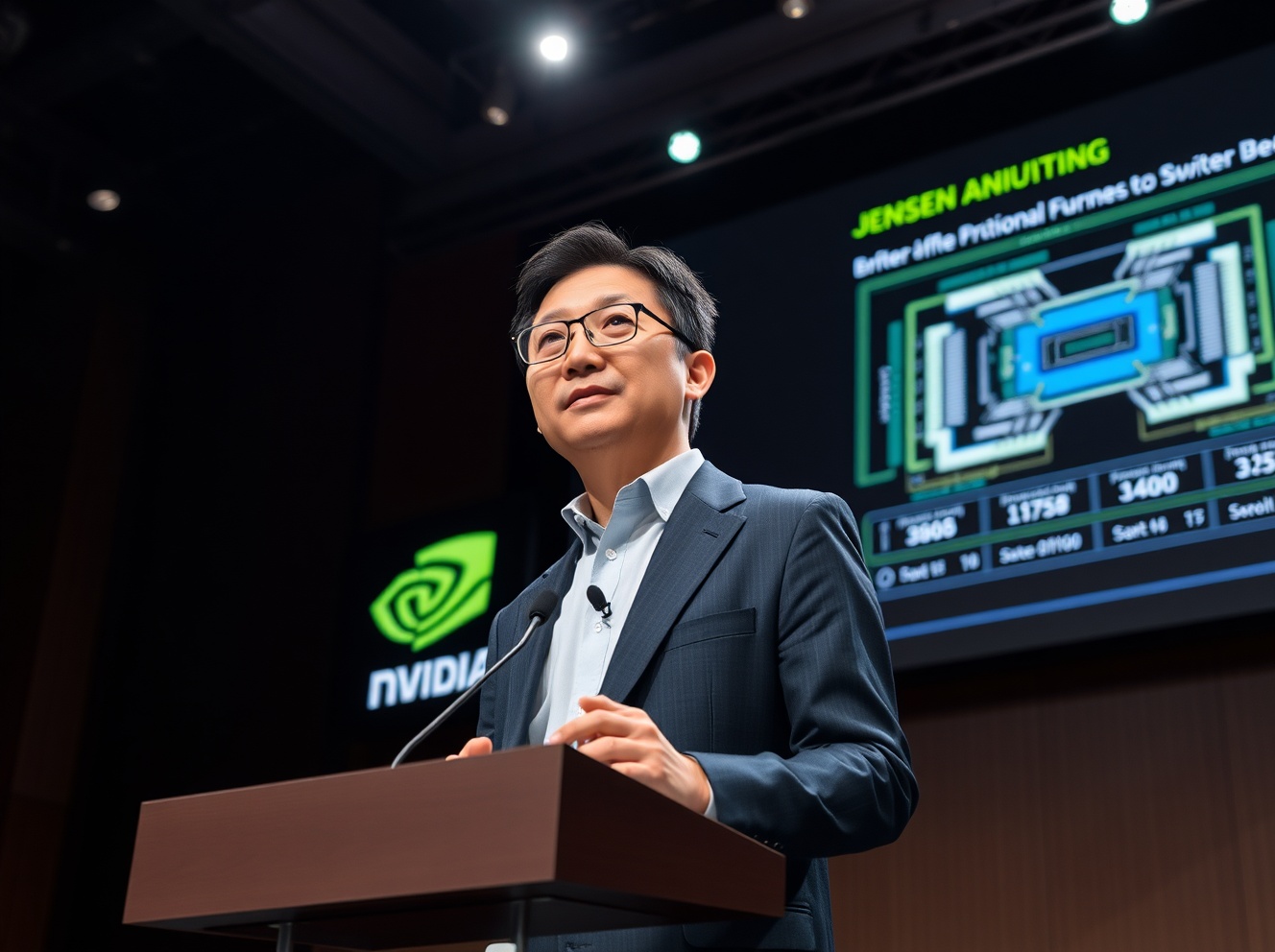
Jensen Huang claims Nvidia’s Vera CPU opens a ‘brand new’ $200 billion market for agentic AI
Nvidia CEO Jensen Huang has a reputation for making bold predictions about his company’s future — and, more often than not, delivering on them. Speaking on the company’s latest earnings call, Huang declared that Nvidia has unlocked a “brand new $200 billion total addressable market” with its recently introduced Vera CPU, a processor he says is purpose-built for the next wave of artificial intelligence: agentic AI.
The Vera CPU and a new market thesis
Huang introduced Vera in March as a standalone product and as part of a bundle with Nvidia’s upcoming Rubin GPU. On Wednesday’s earnings call — following another record-breaking quarter with $81.6 billion in revenue and a forecast of $91 billion for the next quarter — he positioned Vera as a potentially transformative product. “Vera opens a brand new $200 billion TAM for Nvidia, a market we have never addressed before,” Huang said. “Every major hyperscaler and system maker is partnering with us to deploy it.”
According to Huang, the key difference lies in what Vera is designed to do. Traditional cloud CPUs are built to handle multiple application instances as quickly as possible, using many cores. Vera, by contrast, is optimized to process tokens — the fundamental units of data in AI models — as fast as possible. This makes it suited for “agentic AI,” where AI agents perform tasks autonomously rather than simply generating responses. “The world is rebuilding computing for agentic AI and robotic physical AI,” Huang said. “Nvidia sits at the center of these transitions.”
Wall Street’s CPU anxiety and Nvidia’s counterargument
Despite Nvidia’s dominance in GPUs, Wall Street has long harbored concerns about what could disrupt its position. Increasingly, those fears have centered on the CPU market — historically owned by Intel and AMD, but now seeing competition from cloud giants like Amazon Web Services. Last month, AWS announced a large contract with Meta for millions of Amazon’s homegrown AI CPUs, and CEO Andy Jassy has argued that AWS can match or surpass Nvidia in both GPU and CPU AI chips.
Huang’s counterargument is simple: Nvidia has already sold $20 billion worth of standalone Vera CPUs this year, and the company is only getting started. He predicts that as the world moves from billions of human users to billions of AI agents, each agent will need its own CPU-driven environment — essentially a PC for every agent. “The world has a billion users, human users,” Huang said. “My sense is that the world is going to have billions of agents, not today. We’re going to grow into it.”
Why this matters for the enterprise
If Huang’s thesis proves correct, the implications extend beyond Nvidia’s stock price. Enterprise customers building AI-powered workflows — from customer service bots to automated data analysis — will need to rethink their infrastructure. Currently, most AI workloads rely on GPUs for the “thinking” part of the model, but agents run on CPUs for executing tasks. Vera is designed to bridge that gap, potentially making Nvidia a one-stop shop for both training and inference hardware. However, the market is still nascent, and competitors are moving quickly. The question is whether Nvidia’s head start and existing ecosystem partnerships will be enough to fend off the hyperscalers building their own silicon.
Conclusion
Jensen Huang’s $200 billion claim is characteristically bold, but Nvidia’s track record — and the $20 billion in Vera sales already booked — gives it weight. Whether Vera truly becomes a “major new growth driver” or faces the same competitive pressures that have eroded Intel’s dominance remains to be seen. For now, Nvidia is betting that the future of AI runs on its CPUs as much as its GPUs.
FAQs
Q1: What is the Vera CPU?
Vera is Nvidia’s new CPU, introduced in March 2025. It is designed specifically for agentic AI workloads, processing tokens faster than traditional cloud CPUs. It can be purchased standalone or bundled with Nvidia’s Rubin GPU.
Q2: How is agentic AI different from traditional AI?
Agentic AI refers to AI systems that can perform tasks autonomously — such as booking appointments, managing workflows, or controlling robots — rather than just generating text or images. These agents rely heavily on CPUs for executing their assigned tasks.
Q3: Who are Nvidia’s main competitors in the CPU market?
Historically, Intel and AMD dominated the CPU market. However, cloud providers like Amazon Web Services (AWS) are now developing their own AI-focused CPUs, posing a direct challenge to Nvidia’s expansion into this space.
This post Jensen Huang claims Nvidia’s Vera CPU opens a ‘brand new’ $200 billion market for agentic AI first appeared on BitcoinWorld.